 Casa Grande Stucco Repair
 Stucco Crack Repair in Casa Grande
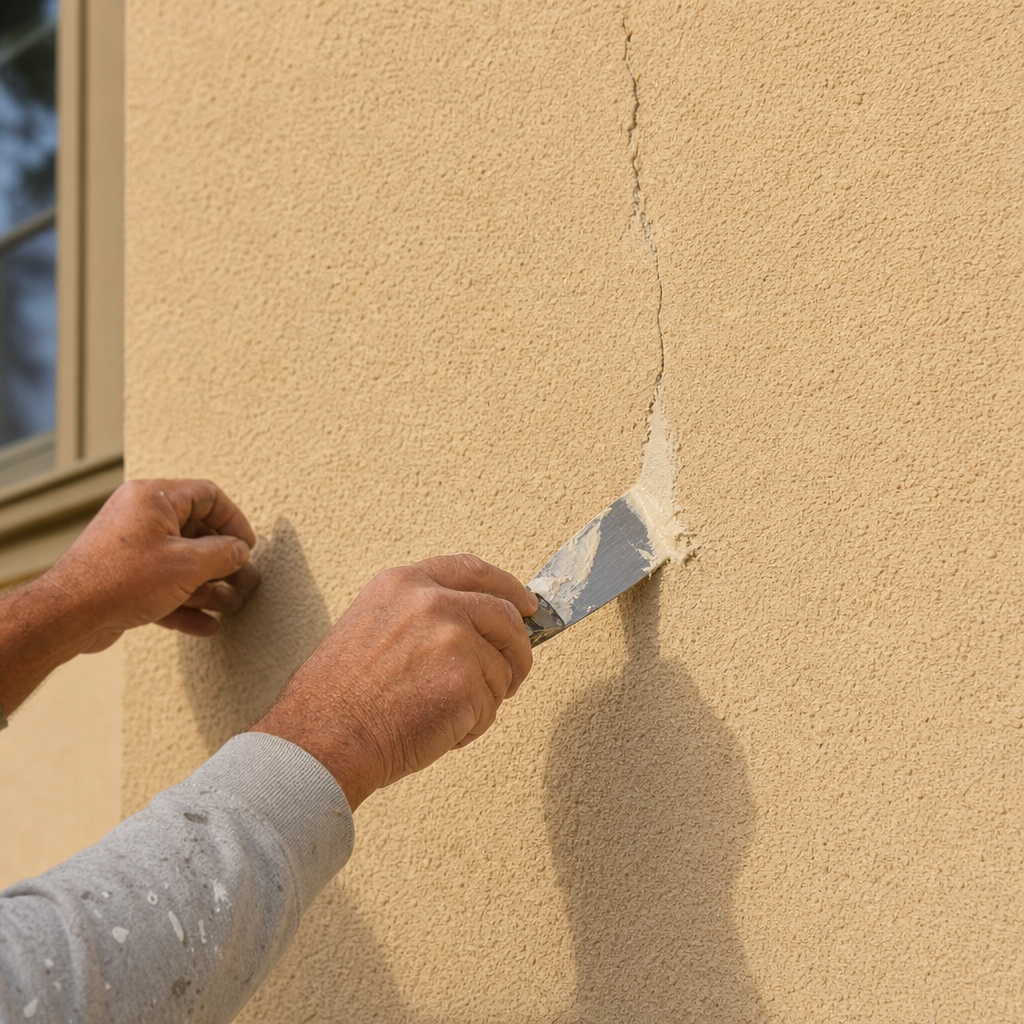
Stucco crack repair in Casa Grande runs $200 to $800 for the typical hairline-to-moderate job, and $8 to $20 per square foot when a larger area is cracked. The work opens the crack, fills it with a material matched to your system, and refinishes the texture so the wall sheds water again and the repair does not announce itself. Cracks at foam trim joints and off window corners are the most common call in the county, and caught before the monsoon they are the cheapest repair in this trade.
Why Casa Grande walls crack
Heat and the daily swing. The NOAA 1991 to 2020 normals for the Casa Grande station put the July mean high at 106.8 degrees and the mean low at 78.1, a 29 degree swing every day. In April and October the gap runs closer to 34 degrees. The station averages 116.8 days a year at 100 or hotter. Stucco expands during the afternoon and shrinks overnight, and where two materials meet, that movement concentrates: foam trim against cement basecoat, a window flange against the wall, a corner where the sheathing changes direction. After a few thousand cycles the finish gives way exactly there. That is why cracks on a 2006 home in Villago trace the trim and window corners instead of wandering across open wall.
One-coat construction. Most of the housing built here since the 1990s, Coyote Ranch, Mission Royale, Ironwood Commons, Villago, the newer phases on the east side, and nearly everything in Maricopa and Coolidge, is one-coat stucco: roughly 1/2 inch of cement basecoat over foam sheathing. Half the thickness of a traditional three-coat wall means half the mass to absorb movement, so cracking telegraphs to the surface faster, and control joints that were skipped or spaced too far apart show up as cracks at the weakest line between them.
Soil. The USDA NRCS soil survey names the valley’s signature soil the Casa Grande series, a sodic clay loam with 18 to 35 percent clay in the subsoil and slow to very slow permeability, over a calcic layer 20 to 40 inches down. Neighboring Pinal-series ground has a silica-lime hardpan, caliche, at 4 to 20 inches. The Arizona Geological Survey flags expansive and collapsing soils across central Arizona basins and lists the tell-tale damage: foundation cracks, cracked slabs and walls, doors and windows that jam. On a stucco house the surface symptom is a stairstep crack near a corner or a diagonal crack from a window corner toward the foundation, and it will return after any surface repair because the ground under it is still moving.
Monsoon. From April through June, Casa Grande normals under 0.6 inches of rain. Then July, August, and September deliver 3.15 inches, about 40 percent of the year’s 7.91 inches, in short storms with outflow winds that drive rain sideways into walls. An open crack in June becomes a wet wall cavity in August. Water behind one-coat stucco has nowhere to go but into the foam sheathing and the framing.
Freeze, barely. The Casa Grande station averages 16.7 nights a year at or below 32 degrees. Water in a saturated crack does expand when it freezes, so a January cold snap will open a wet hairline a little wider, but freeze-thaw is a minor factor here compared with heat and monsoon, and it is not the villain.
Reading the crack: what matters and what does not
| What you see | What it usually means | What to do |
|---|---|---|
| Fine spiderweb over a whole wall | Finish coat fatigue, cosmetic | Fog coat, recoat, or elastomeric of the elevation |
| Hairline along a foam trim joint | Thermal movement at the joint | Re-mesh and reseal the joint before monsoon |
| Diagonal crack off a window or door corner | Stress concentration, sometimes settlement | Repair now; watch for return |
| Stairstep crack near a building corner | Soil movement under the footing | Repair plus a foundation conversation |
| Vertical crack with a stain below | Water entering from above (scupper, trim, roof edge) | Fix the source first, then the crack |
| Crack you can fit a credit card into | Open water path | Repair before July |
| Crack plus hollow sound when tapped | Delamination behind it | This is a patch, not a crack repair |
The tap test decides the last row. Sound stucco raps solid; delaminated stucco sounds like a drum. If the area around the crack is hollow, filling the crack is cosmetic and the honest job is stucco patching.
Our crack repair, step by step
- Trace it. Follow the crack to its cause. A trim joint, a window corner, a corner of the building, a scupper above, a sprinkler below. The cause decides the fix.
- Open it. Hairlines get cleaned and opened slightly so material can key in; wider cracks get routed to a V so the fill bonds to sound edges instead of sitting on dust.
- Fill it with the right material. On cement stucco a flexible elastomeric patching compound for moving thermal cracks, or cement-based patch for static cracks in sound wall. On foam trim, new mesh embedded in acrylic basecoat across the joint. On EIFS, EIFS-specific basecoat and mesh, never cement.
- Refinish the texture. The patch is textured to match the wall: sand float, lace, dash, or the smooth troweled finish on the newer builds, feathered out so the edge disappears.
- Blend the color. Pigmented finish or fog coat blended to the weathered wall, judged dry, in daylight. See color and texture matching for what is and is not possible on a twenty-year-old wall.
- Address the cause. If a sprinkler is soaking the wall or rock is piled over the weep screed, that goes on the quote too, or the repair is a subscription.
When crack repair is not the answer
Map cracking across a whole elevation cannot be chased crack by crack. If the wall is sound, the right move is a fog coat or recoat (see restucco and recoating) for the true cement look, or an elastomeric coating if you want the cracks bridged and the wall sealed in one pass.
Cracks that return after competent repair have a moving cause. Recurring trim cracks usually mean the trim needs re-meshing and proper joints rather than another bead of sealant; see foam trim and parapet repair. Recurring stairstep cracks mean soil, and that is a foundation contractor’s conversation before it is a plasterer’s. Find out which one you have before paying for a third patch.
Cracks with a hollow wall behind them are patches, priced $500 to $2,000, because the paper and lath have to be rebuilt, not just the surface.
Timing and pricing
Cement patch material cures badly at 100-plus degrees in direct sun, so summer crack work is done early, in shade, and misted. October through May is easier on everyone. The strategic deadline is June 15, the start of the National Weather Service monsoon season, because the same crack costs $300 to seal in June and considerably more to patch in October.
Crack repair pricing is on the pricing page alongside everything else. Crack repair is covered across Casa Grande and out to Maricopa, Coolidge, Eloy, Florence, and Arizona City. Send a wide shot of the wall, a close-up of the crack with something for scale, and a photo of whatever is above or below it. That supports a read on cosmetic versus repair-now, and a number.
Frequently Asked Questions
How much does stucco crack repair cost in Casa Grande?
Typical hairline and moderate crack jobs run $200 to $800. Larger cracked areas are priced at $8 to $20 per square foot. Most crews carry a $300 to $500 service minimum, so batching several cracks into one visit is the economical move.
Which cracks are just cosmetic?
Fine map cracking, the spiderweb pattern on a sun-faded wall, is the finish coat fatiguing under the daily thermal swing and is mostly cosmetic. It is not sealable crack by crack; if it bothers you or if the wall is chalky, a fog coat or elastomeric coating of that elevation is the honest fix.
Which cracks need repair now?
Anything you can slide a credit card into, diagonal cracks running off window and door corners, stairstep cracks near building corners, cracks along foam trim joints, and any crack with a stain or soft stucco below it. Those are open paths for monsoon rain.
Why does the crack come back after it was patched?
Because the cause is still moving. Thermal joints at trim keep cycling, and soil movement keeps working the corners. Casa Grande's soils are sodic clay loams over shallow caliche per the USDA NRCS survey. A returning stairstep crack is a foundation question, not a job for a third patch.
Can I just caulk it myself?
For a single hairline on a sound wall, a quality elastomeric sealant will buy time. For anything wider or recurring, caulk over a moving crack fails within a season and traps water behind it. A proper repair opens the crack, fills it with a material matched to the system, and refinishes the texture so it sheds water and does not show.