 Casa Grande Stucco Repair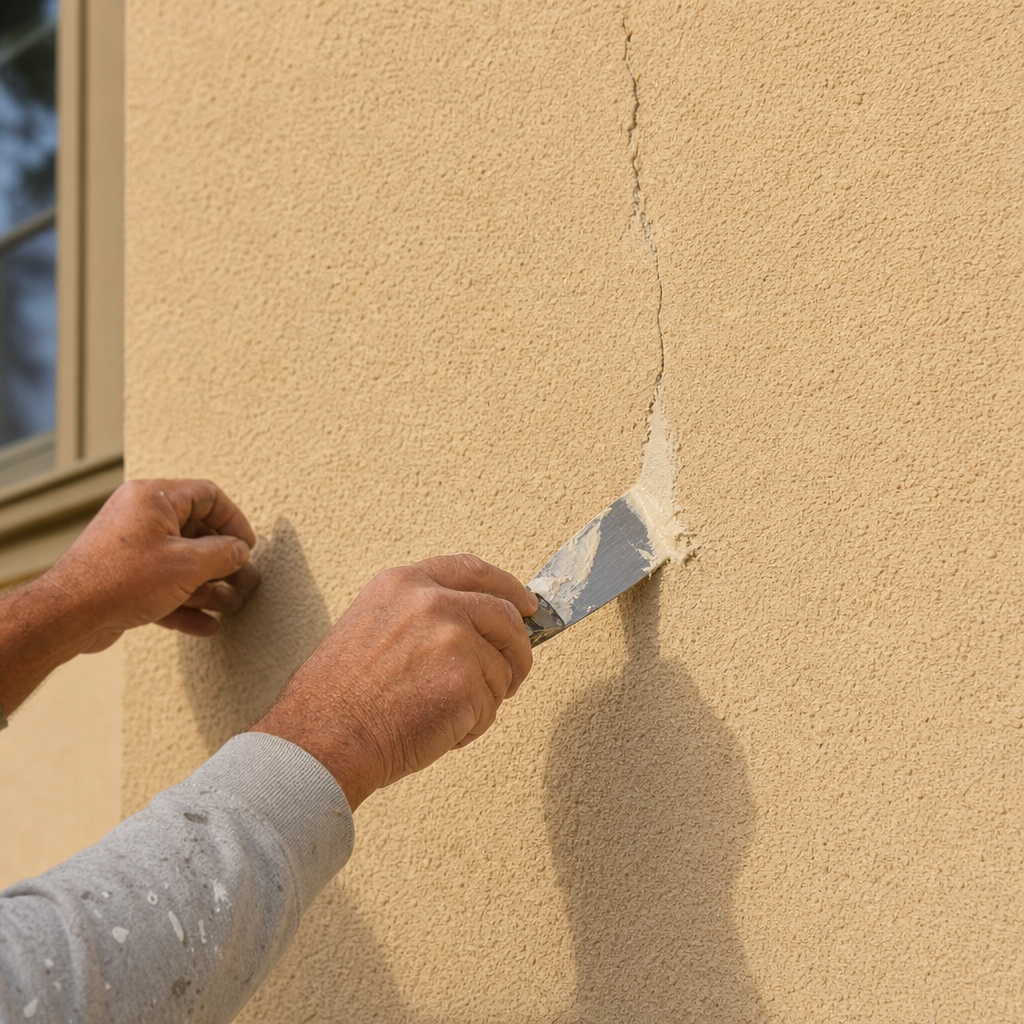

Casa Grande Stucco Repair fixes cracked, stained, hollow, chalky, and failing walls across Casa Grande and western Pinal County. Typical crack repairs run $200 to $800, patching $500 to $2,000, foam trim and parapet repairs $800 to $1,500, and a full restucco $6 to $9 per square foot. Send a few photos of the damage and get a fast, honest quote. No salesman walk-through required.
Nearly every house in Casa Grande wears stucco. The 1990s tract homes in Coyote Ranch, the 2003 to 2009 boom stock in Mission Royale, Ironwood Commons, and Villago, the new phases still going up on the east side, and the older block homes near downtown that were re-skinned somewhere along the way. When an exterior fails here, it fails as stucco: cracked foam trim, diagonal cracks off window corners, chalky south walls, soft spots at the base where the sprinklers hit. That is the whole trade we cover.
The stucco work we do
- Stucco crack repair: hairlines through structural cracks, opened up, filled, and refinished to keep water out of the wall.
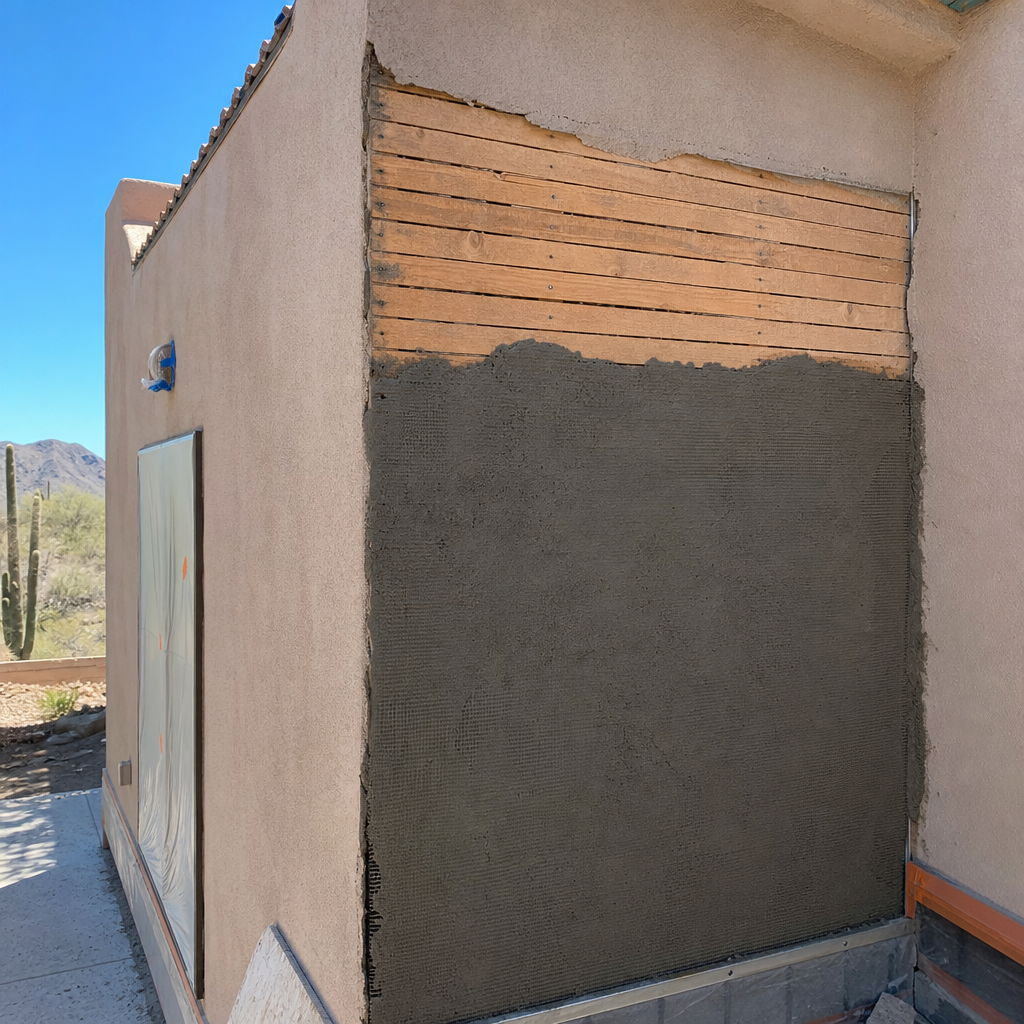
- Stucco patching: we cut out hollow, delaminated, or blown-out sections and rebuild them over new paper and lath in cement coats instead of skimming them.
- Foam trim and parapet repair: cracked trim joints, pop-outs, and flat-roof parapet caps repaired before they leak. The most common call in this county.
- Restucco and recoating: once a wall is beyond patching, a fresh finish coat or a full restucco.
- Elastomeric coating: one flexible, waterproof skin over an entire elevation that spans its hairline cracks.
- Color and texture matching: we blend each repair into the sun-faded wall around it so nobody spots the fix.
Why Casa Grande is hard on stucco
The heat is the main event. The NOAA 1991 to 2020 climate normals for the Casa Grande station put the July mean high at 106.8 degrees, with June at 105.8 and August at 105.3. The station averages 116.8 days a year at 100 degrees or hotter and 183.8 days at 90 or hotter. A south or west wall in Villago sits in that for half the year. Pigmented cement finishes chalk and fade under that much UV, acrylic finish coats on foam trim get brittle, and sealant at every joint dries out and pulls away.
The daily swing works every joint. Even in July the wall goes from a 78 degree night to a 107 degree afternoon, and in April and October the swing between the mean high and mean low is closer to 34 degrees. Stucco expands in the heat and shrinks at night, every day, all year. Where two materials meet, foam trim against cement, a window flange against the basecoat, a control joint that was never cut, that movement concentrates and the finish cracks. This is why the cracks on a fifteen-year-old production home in Mission Royale trace the trim and the window corners rather than wandering across open wall.
Then the monsoon hits a wall that has baked since April. April, May, and June together normal under 0.6 inches of rain here. Then July, August, and September deliver 3.15 inches, about 40 percent of the year’s 7.91 inches, most of it in short, violent bursts driven sideways by outflow winds. The National Weather Service runs the monsoon season June 15 to September 30. Water hits open cracks, dried-out trim joints, and unflashed scuppers all at once, and mid-summer is when “small” stucco problems announce themselves as interior stains.
Dust is part of the weather. The EPA designated the West Pinal PM10 nonattainment area, which takes in Casa Grande, Maricopa, and Eloy, as Moderate in 2012 and reclassified it Serious in 2020. Pinal County’s inventory attributes about half of that particulate to windblown dust. Fine dust packs into map cracks, holds moisture against the basecoat, and grinds the finish on windward walls. Haboob outflow also throws debris at foam trim, and a cracked corner bead lets the first storm in.
The ground moves. The USDA NRCS soil survey names this valley’s signature soil the Casa Grande series, Arizona’s representative state soil: a sodic clay-loam subsoil with 18 to 35 percent clay and slow to very slow permeability, over a calcic layer 20 to 40 inches down. Nearby Pinal-series ground carries a silica-lime hardpan, the caliche every pool contractor here curses, at just 4 to 20 inches. The Arizona Geological Survey flags expansive and collapsing soils across central Arizona basins and lists the symptoms plainly: foundation cracks, heaving and cracking of slabs and walls, jammed doors and windows. On a stucco house that shows up as a stairstep crack near a corner or a diagonal crack off a window, and patching it without asking why is how you pay for the same crack twice.
Freeze is minor. The Casa Grande station averages 16.7 nights a year at or below 32 degrees, and the Casa Grande Ruins station up in Coolidge about 29. That is enough to open a saturated hairline crack a little wider in January, but it is nothing like the freeze-thaw punishment stucco takes in Flagstaff or New Mexico. Anyone selling you freeze damage in Casa Grande is selling.
Three stucco systems, one foam trim problem
Getting the system right before touching the wall is half the job:
- One-coat: a single roughly 1/2 inch cement basecoat over foam sheathing, then a finish coat. This is most of the 1990s to 2020s production housing in Casa Grande, Maricopa, and Coolidge. Thinner, so impacts and cracking telegraph faster, and every window and trim joint is a hinge point.
- Traditional three-coat: paper, wire lath, then roughly 3/4 inch of cement scratch and brown coat plus a finish coat. Older homes, most custom homes, and most block homes that were stuccoed.
- Synthetic / EIFS: foam board, fiberglass mesh in polymer basecoat, acrylic finish. Mostly commercial buildings and some custom homes. It dents more easily and holds water behind it once the sealant joints go. We fix EIFS only with EIFS parts and cement stucco only with cement; mixing the two is how a repair fails.
And the detail that generates more calls than any of them: foam trim. Nearly every production home built here since the 1990s wears expanded polystyrene shapes around windows, along the roofline, and at parapet caps, skinned with a thin acrylic basecoat and mesh. The joints between trim pieces and the joint where trim meets wall are the first things to crack under the daily thermal swing, and once open they funnel water behind the stucco. See foam trim and parapet repair.
Our repair process, step by step
- Sound the wall and find the cause. Tap for hollow spots, trace cracks to their source (thermal joint, settlement, a scupper, sprinkler spray, a buried weep screed) and identify the system before anything gets cut.
- Cut back to sound material. We saw-cut and chip the failed stucco out beyond what you can see. Rusted lath and rotten paper come out. Nobody skims over a soft spot.
- Rebuild the weather barrier. New paper lapped shingle-style into the existing, new galvanized lath tied in, flashing corrected at trim, scuppers, and penetrations. This step is where cheap patches fail.
- Scratch and brown coat, properly cured. Cement basecoats are moist-cured, and in a Casa Grande summer that means shade, early starts, and misting so the coat does not flash-dry and shrink-crack within a season.
- Finish, texture, and color. The finish coat replicates your texture and feathers into the wall, and color is blended to the weathered wall in daylight, judged dry, because cement finishes shift color as they cure.
Honest pricing, published
| Repair | Typical range |
|---|---|
| Crack repair | $200 to $800 |
| Patching (lath exposed) | $500 to $2,000 |
| Foam trim / parapet repair | $800 to $1,500, rebuilds $3,000 to $10,000 |
| Elastomeric coating | $1.50 to $3.50 per sq ft |
| Recoat / full restucco | $3 to $6 / $6 to $9 per sq ft |
Full breakdowns, what moves the number, and what a whole-house job costs are on the pricing page. In short, three things set the price: which system is on the wall, how hard it is to reach, and how far the water got, and photos show us all three. Caught early, most of this table stays at the affordable end of exterior work. It is the deferred version, after a couple of monsoons, that climbs into rebuild money.
Licensing, a fund behind it, and a warning about the $1,000 rule
Stucco and lath work in Arizona is regulated by the Registrar of Contractors under the Plastering classification, R-36 for residential, C-36 for commercial, CR-36 dual. Look up anyone you hire on the ROC site before they set a ladder, us included.
That matters for a reason beyond paperwork. Arizona’s Residential Contractors’ Recovery Fund can pay an owner-occupant up to $30,000 per residence (and $200,000 per contractor license) when a properly licensed residential contractor abandons or botches the job. Hire an unlicensed patcher and that safety net does not exist. Arizona’s handyman exemption, A.R.S. 32-1121, only covers work under $1,000 total including materials, of a casual or minor nature, that needs no permit, and it forbids splitting a job into pieces to duck the limit. A 2025 bill to raise that cap to $3,500 died in the House, so $1,000 still stands. Most real stucco repairs clear it in the first hour.
Who needs stucco repair here
Casa Grande went from 25,224 people at the 2000 census to 53,658 in 2020 and an estimated 68,927 in 2024, and the whole west side of the county grew with it: Maricopa went from 1,040 to 58,125 in the same twenty years, Coolidge was Arizona’s fastest-growing city from 2020 to 2025, and Lucid’s plant and Kohler’s 2024 factory keep pulling in households. Most of that housing was built fast, in one-coat stucco, in a boom. The first wave is now 15 to 25 years old, which is exactly when foam trim joints open, finish coats chalk, and the first patches from the builder’s punch list fail. That is the work.
Straight answers, independently run
We are an independently operated local stucco service. A wall that needs a recoat should not be sold a patch, and a $400 crack repair should not be sold as a recoat. If a crack keeps coming back, the cause is moving (soil, a parapet, a bond beam), and a third patch will not stop it.
The service area runs across Casa Grande and out to Maricopa, Coolidge, Eloy, Florence, and Arizona City. Anywhere in western Pinal County is ground we work. Send photos of the damage, a wide shot of the elevation and a close-up of the worst spot, so we can give you a real number and a realistic timeline. Questions first? The FAQ covers the common ones, and about how this works explains how we quote.