 Casa Grande Stucco Repair
 Restucco and Recoating in Casa Grande
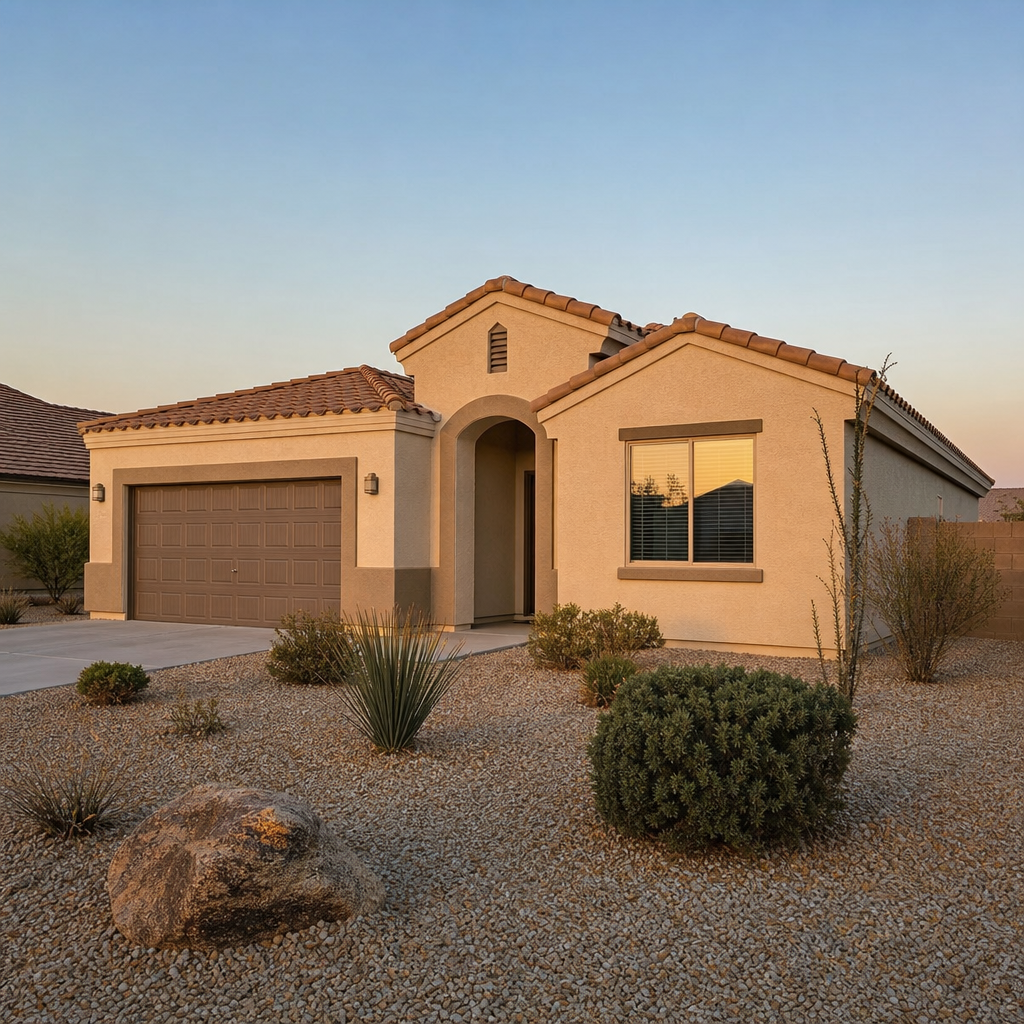
Restucco and recoating in Casa Grande run $3 to $6 per square foot for a recoat (a new cement finish coat over sound basecoats) and $6 to $9 per square foot for a full restucco that strips the wall and rebuilds paper, lath, basecoats, and finish. Smooth troweled and specialty finishes run $10 to $14. A whole-house restucco commonly lands between $12,000 and $20,000; one or two elevations, $3,000 to $8,000. Which one you need is decided by tapping the wall, not by how tired it looks from the curb.
Why Casa Grande walls wear out
This valley runs a specific program on stucco finishes. The NOAA 1991 to 2020 normals for the Casa Grande station show 116.8 days a year at 100 degrees or hotter, a July mean high of 106.8, and 183.8 days at 90 or hotter. Pigment in a cement finish coat is not built for that much UV; over fifteen to twenty years it chalks, fades two or three shades on the south and west faces, and loses the fine texture detail. Meanwhile the daily thermal swing, 29 degrees in July and about 34 in April and October, works the finish coat until it map-cracks in the spiderweb pattern you see on nearly every elevation in Coyote Ranch and the older streets of Mission Royale. Dust does the rest: the West Pinal PM10 nonattainment area, which EPA reclassified Serious in 2020, gets about half its particulate from windblown dust per the county inventory, and years of it scour the finish on windward walls.
By year 15 to 25 the typical Casa Grande wall is cosmetically exhausted. The question is whether it is only cosmetically exhausted. Everything hinges on that.
The tap test decides
A wall can look terrible and be structurally perfect, or look passable and be delaminated across half an elevation. We find out by sounding it, which means tapping across the wall in a pattern and listening to each spot. Well-bonded stucco raps solid; delaminated stucco sounds hollow. Add three visual checks, rust staining bleeding through the surface (the lath is corroding), vertical stains below scuppers or trim (water is in the wall), and crack width (hairlines versus anything a credit card slides into), and you have the diagnosis:
Sound wall, fine cracking, fading: recoat or coating territory. Hollow areas, rust, water staining, wide cracks: patch or restucco territory.
Anyone who quotes a restucco without sounding your walls is guessing with your money.
Recoat: $3 to $6 per square foot
A recoat is a new cement finish coat, usually with a bonding agent, over basecoats that are still solid. It restores the authentic flat cement look, a fresh wear surface, and a new color, and it is the right call when the wall is sound and you want the traditional finish rather than a membrane. Preparation matters: pressure washing to remove chalk, repair of any isolated cracks or small hollow spots first (see crack repair and patching), and bonding agent so the new coat grabs.
Its limit is honesty about rigidity. Cement is cement, and the map cracking that fatigued the old finish will eventually revisit the new one. If crack-bridging matters more to you than the true cement texture, the elastomeric coating page is the other side of that choice, at $1.50 to $3.50 per square foot. On a sound wall it is a legitimate taste call.
A fog coat is the lightest version: a thin cement-and-pigment wash that renews color without adding a full finish coat. It is how a patched elevation gets unified when the patch will not otherwise blend, and it is priced by area within the recoat range.
Full restucco: $6 to $9 per square foot
A full restucco strips the wall system and rebuilds it. On most Casa Grande homes that means one-coat stucco: about 1/2 inch of cement over foam sheathing, the standard on the 2003 to 2009 boom stock in Ironwood Commons, Villago, and Mission Royale and on nearly everything built since. Demo takes the failed stucco off, water-damaged foam sheathing gets replaced, and the wall gets new water-resistive paper, new galvanized lath, corrected flashing at windows, scuppers, and penetrations, fresh basecoats moist-cured, and a new finish in your texture. On older three-coat homes the rebuild is thicker and costs toward the top of the range.
You are not buying looks. You are buying a new weather barrier. That is the point people miss in both directions: restucco is overkill for a sound wall that needs a facelift, and it is the only real fix for a wall whose barrier has failed. Coating or recoating over rusted lath and rotten paper does not stop the rot; it hides the evidence while the water keeps working.
Standard finishes (sand float, lace, dash) run $6 to $9. Smooth troweled Santa Fe-style finishes and specialty textures run $10 to $14 because they take more coats, more skill, and more time. Whole-house numbers land between $12,000 and $20,000 for a typical single-story home, driven by wall area, two-story access, and how much sheathing has to be replaced. See the pricing page for the full table.
Partial restucco: the sun-side job
Casa Grande’s south and west elevations take far more UV than the north, so partial restucco or recoat of one or two walls is common and sensible, at $3,000 to $8,000. The craft is at the corners. New finish next to a wall that has weathered for twenty years will not match the original color chip; it has to be blended to the adjoining faded wall, judged dry in daylight, or the seam shows. That is the subject of the color and texture matching page, and it is the reason to ask up front which corners will be seamless and which will need a fog coat to unify.
The decision, compressed
| Your wall | The honest fix | Cost |
|---|---|---|
| Sound, faded, want the true cement look | Recoat | $3 to $6 / sq ft |
| Sound, map-cracked, want it sealed and refreshed | Elastomeric coating | $1.50 to $3.50 / sq ft |
| Localized damage, rest of wall sound | Patch plus fog coat | per repair |
| Hollow areas, rust stains, failed paper or lath | Full restucco | $6 to $9 / sq ft |
| Smooth or specialty finish | Full restucco | $10 to $14 / sq ft |
Sequence, timing, permits
Sequence first: if a parapet cap, foam trim joint, or scupper is leaking, it gets fixed before any recoat or restucco; new material under an active leak is on a countdown. See foam trim and parapet repair. Timing second: cement does not want to be applied at 105 degrees in direct sun, so summer restucco is worked in shade with early starts and misting, and October through May goes faster. The deadline is June 15, the start of the National Weather Service monsoon season, because a sealed wall in June sheds the 3.15 inches of July to September rain that an open, map-cracked wall absorbs.
Like-for-like restucco is finish work under the City of Casa Grande Building and Technical Administrative Code and normally needs no permit; anything structural uncovered during demo needs a building permit; check with the City of Casa Grande building office, or Pinal County building for addresses outside city limits, before work starts. HOA communities generally require architectural approval for a color change and not for a same-color recoat.
Recoat and restucco work is covered across Casa Grande and out to Maricopa, Coolidge, Eloy, Florence, and Arizona City. Send wide shots of each elevation and close-ups of the worst areas, and ask which row of that table you are in, including when the cheap row is the right one.
Frequently Asked Questions
What does it cost to restucco a house in Casa Grande?
A full restucco runs $6 to $9 per square foot of wall for standard finishes and $10 to $14 for smooth troweled or specialty finishes. Whole-house jobs commonly land between $12,000 and $20,000; one or two elevations run $3,000 to $8,000. A recoat, a new finish coat over sound basecoats, is $3 to $6 per square foot.
Recoat or full restucco, how do I know which I need?
Tap the wall. If it sounds solid everywhere and the problem is faded, chalky, map-cracked finish, a recoat restores it. If it sounds hollow, shows rust bleeding through, or has stained and soft areas, the weather barrier behind it has failed and a recoat only hides that. Restucco is the honest fix there.
Can you restucco just the sun-beaten side?
Yes. Partial restucco or recoat of one or two elevations is common here because the south and west walls take far more UV than the north side. Expect $3,000 to $8,000 for a partial. The color match at the corners is the craft; the blend targets the adjoining weathered walls rather than the original chip.
Do I need a permit or HOA approval to restucco?
Like-for-like restucco and recoating is finish work under the City of Casa Grande's building code and normally needs no permit; structural repairs uncovered during demo are different and need a building permit from the City of Casa Grande building office, or Pinal County building outside city limits. If you are in an HOA subdivision and changing color, get architectural approval first. Same color, usually not required.
How long does a restucco take?
Demo and lath on a single-story home take a few days, then scratch and brown coats with cure time between them, then the finish. Two to three weeks is typical, longer in summer because cement has to be worked in shade and moist-cured when the highs run 105 or more.